Reading time: 6 minutes
The crises of recent years have fundamentally reshaped Europe’s energy market, highlighting the delicate balance between security of supply, affordability and sustainability. At the June 3 event of the Transylvania Lectures series, held at the Kolozsvá/Cluj-Napoca centre of Mathias Corvinus Collegium (MCC), experts discussed the challenges Europe is facing, how the green transition can be accelerated, and what role Romania, Serbia and regional cooperation may play in shaping the continent’s energy future.
As Europe navigates market shifts and energy-sector transformations, households, businesses and governments alike are confronted with questions of security of supply, affordability and sustainability. How do global political developments affect the energy market? How can Europe become a greener continent while keeping energy accessible and secure?
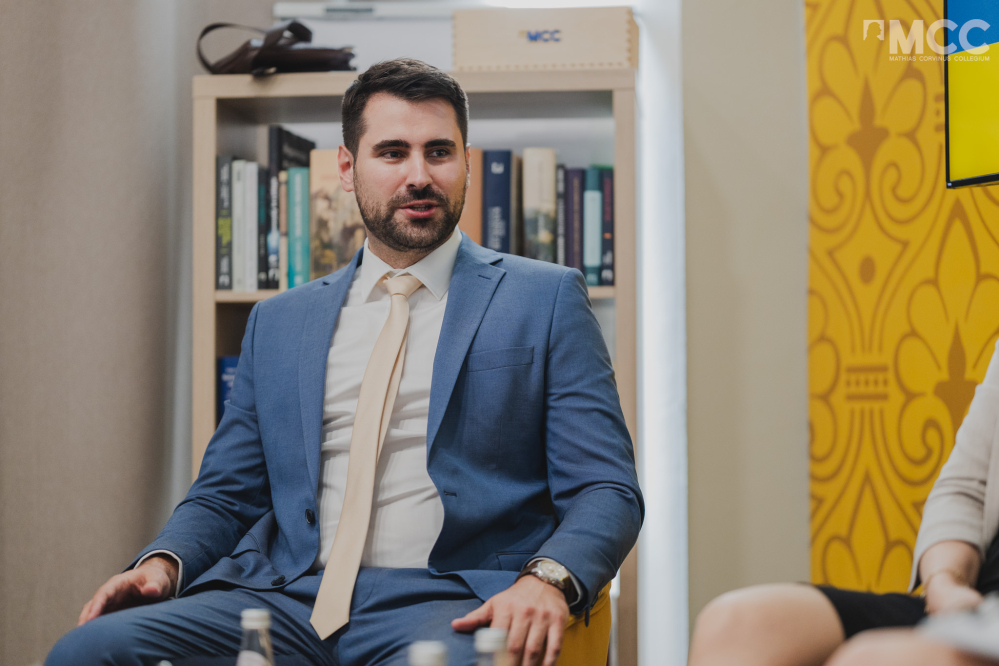
These were the questions addressed at the June 3 event of the Transylvania Lectures series, where Dr. Oana Raita, senior researcher at INCDTM – the National Institute for Research and Development of Isotopic and Molecular Technologies –, head of the Energy Team and executive director of the Transylvania Energy Cluster, and Dr. Strahinja Obrenović, expert in energy law and energy policy and assistant professor at the Faculty of Political Science of the University of Belgrade, discussed Europe’s energy future. The conversation was moderated by Alia Hărșan-Farr, a student of the MCC University Program.
Over the past four years, Europe has faced a series of major challenges: the pandemic, the war in Ukraine and the situation in the Middle East have all contributed to uncertainty on the energy market. Dr. Oana Raita emphasized that the issue is not simply that less energy is available because of Europe’s dependence on Russian gas. In her view, “as individuals and as a continent, we must think about how we use the amount we already have.”
According to Dr. Strahinja Obrenović, lawmakers working on today’s energy policy must keep the so-called “energy triangle” in mind: energy must be affordable for everyone, including the most disadvantaged groups; supply must remain continuous and secure; and sustainability considerations must not be overlooked. “Energy production has become a democratized process, because for the first time in history, citizens are not only consumers, but also producers,” he said.
Dr. Oana Raita added that Romania is currently in a more favourable position than, for example, Germany or France. Cluj-Napoca is also among the Romanian cities that have made significant investments in green energy in recent years.
“Before 2022, no one really thought about where our electricity and gas came from,” noted Alia Hărșan-Farr. According to Dr. Oana Raita, the war in Ukraine accelerated efforts toward energy independence and energy efficiency. At the same time, countries should change their consumption habits regardless of this context, although socio-psychological factors also come into play. The speaker illustrated this with a personal example: her mother, who grew up under communism, still does not like turning off the lights, as she spent much of her youth in darkness.
Dr. Strahinja Obrenović pointed out that although the transition to renewable energy has accelerated in EU countries, there is growing tension between ageing infrastructure and rising energy demand. Tech giants such as Microsoft and Google are trying to address this problem by building their own power plants. At the same time, solar energy storage remains a serious challenge. Although the technology itself has become more accessible and affordable, there is still no adequate solution for using the energy produced efficiently over the long term.
According to Dr. Oana Raita, another issue in Romania is that many people are not prepared for all the costs associated with solar panels. It is not only the installation that must be paid for, but also later maintenance, inspections and upkeep. In addition, the state does not pay for the surplus energy produced. This can easily discourage people, as they may feel that green energy primarily represents a major investment with uncertain returns.
The question was also raised: is energy an economic or a social issue? According to Dr. Oana Raita, the two do not exclude each other, since accessibility, sustainability and production are closely connected. The experts agreed that because energy is almost a basic necessity, without which our everyday activities would practically come to a halt, it must be approached differently from an ordinary product or service.
Referring to the days-long power outage in Spain, Dr. Oana Raita also drew attention to the importance of diversification. In her view, it is essential for countries not to rely on a single energy source, but to make the best possible use of their natural assets. It would also be a step forward if, alongside national grids, smaller communities were able to produce part of their own consumption. At the same time, the transition requires transparency, honest communication and education between the state and its citizens.
“Renewable energy can be both an answer to the climate crisis and to the question of energy independence,” was stated during the discussion. But how quickly can these sources meet consumer demand? According to Dr. Oana Raita, they will never be sufficient on their own: other energy sources will always be needed as well. Nuclear energy, for example, can be a good compromise, as under the right conditions it can provide large amounts of energy with a low environmental impact. Albania’s example also shows the importance of diversification: the country generates a significant share of its consumption from hydropower, which is an advantage, but it can also pose a risk if there is not enough rainfall in a given year.
Although the guests were optimistic about renewable energy, they see the future in a more balanced energy mix. In countries such as Norway, for example, where periods of darkness can last for a long time, it is not realistic to cover total energy needs exclusively through solar power or other green technologies. According to the experts, EU countries could also benefit in the future from the development of common green networks. As an example, they mentioned the hydropower system operating between Romania and Serbia, whose principle is that the country producing more energy at a given moment helps the other.
The introduction of innovations is moving in the right direction, but it is a time-consuming process. According to Dr. Oana Raita, the tightening of legal and permitting procedures, as well as uncertainty among the population, can both slow down the transition. Dr. Strahinja Obrenović explained that in Serbia, the lack of cooperation between different ministries makes the work more difficult. For investors, predictability, especially in legislation, would be essential, yet both countries struggle with this. “The government in power today may fall tomorrow, and the law we followed last week may no longer be relevant next week,” said Dr. Oana Raita.
At the same time, Europe is difficult to compare with the fastest-developing countries. One of the biggest differences between EU countries and China, Taiwan or even the United Arab Emirates is that in the latter cases, innovation is often less constrained by regulation, allowing new solutions to be introduced more quickly. The experts agreed, however, that in the long run, Europe may still come out ahead, as the purpose of these regulations is to create a cleaner, healthier and more sustainable future.